
If you opened a Google Ads account today expecting to manage it the way you did three years ago, you’d probably feel a bit lost.
Remember the old PPC playbook? You’d sit down, spend hours mining long-tail keywords, set manual Cost-Per-Click (CPC) bids, tightly isolate exact match ad groups, and tweak ad copy headline by headline. It was tedious, but it gave media buyers a comforting sense of direct control.
That playbook is officially obsolete.
In 2026, Google Ads is thoroughly AI-native. With features like Performance Max, broad match paired with Smart Bidding, and generative ad tools, the machine is running the engine.
So, where does that leave PPC managers, agencies, and marketing leaders? Far from making human strategy obsolete, AI has actually raised the stakes. When everyone has access to the same machine learning models, strategy, data hygiene, and creative direction are your only remaining competitive advantages.
Here is how AI is reshaping Google Ads strategy in 2026—and what you need to do to stay profitable.
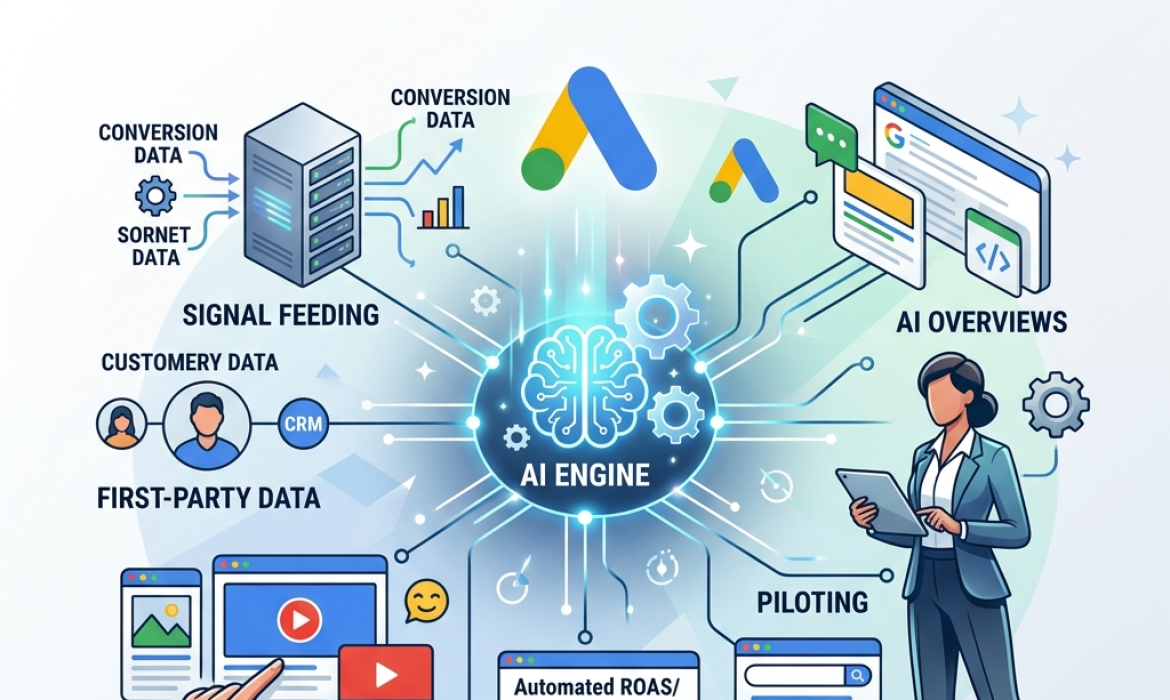
1. From "Keyword Bidding" to "Signal Feeding"
In the past, PPC strategy was built around keywords. Today, it’s built around conversion signals.
Google’s Smart Bidding algorithms process millions of real-time signals every second—user device, physical location, time of day, browsing history, and contextual search intent. The machine can calculate the exact likelihood of a click converting far better than any human manager looking at a spreadsheet.
Because the algorithm handles the micro-adjustments, your new job isn’t tweaking bids by $0.10. Your job is feeding the AI clean, high-value data.
First-Party Data is Everything: With third-party tracking severely degraded, success relies on your own customer data. Connecting your CRM to Google Ads via Offline Conversion Imports (OCI) ensures the algorithm isn’t optimizing for cheap, junk leads, but for closed-won revenue.
Enhanced Conversions & Value Rules: Implementing server-side tagging and value-based bidding tells Google which conversions are worth more to your bottom line, steering spend toward high-margin products or target customer profiles.
Rule of Thumb for 2026: Garbage data in, garbage leads out. If you feed the AI weak conversion signals, it will enthusiastically waste your budget finding more people who don’t buy.
2. Creative Has Become the New "Targeting"
For over a decade, audience targeting was handled behind the scenes through demographic toggles and precise keyword match types. In 2026, your creative assets do the heavy lifting of targeting.
With campaign formats like Performance Max (PMax) pulling levers across Search, YouTube, Gmail, Maps, and Display simultaneously, Google’s generative AI blends video, image, and text assets on the fly.
The algorithm uses your ad messaging to self-select the audience. If your ad creative is vague, boring, or generic, Google will show it to a broad, irrelevant audience. If your creative speaks sharply to a specific customer pain point, the algorithm finds people who resonate with that message.
What this means for your strategy:
Focus on Asset Diversity: Stop uploading 3 static images and a text headline. You need a mix of short-form video (9:16), high-res landscape images, bold social proof, and problem-aware copy angles.
Steer generative AI tools: Tools like Google’s Asset Studio can generate creative variations in seconds. But auto-generated assets without human oversight often look robotic and dilute brand trust. Humans must provide the messaging strategy, brand guardrails, and emotional hooks.
3. Navigating Search Behavior in the Era of AI Overviews
Search behavior itself has fundamentally shifted. People no longer just type robotic, two-word search queries like “best CRM software.” They type full, conversational prompts into search bars and expect immediate answers.
At the same time, Google’s AI Overviews now answer complex questions directly at the top of the Search Engine Results Page (SERP).
This creates a split in PPC traffic:
Informational queries get answered instantly on the SERP, reducing generic “top-of-funnel” clicks.
High-intent commercial queries (“hire a B2B SaaS accountant near me”) are more valuable—and competitive—than ever.
To adapt, modern PPC strategists use broad match keywords paired with extensive, disciplined account-level negative keyword lists. Broad match lets Google’s AI capture nuanced, conversational queries you couldn’t possibly brainstorm manually, while negative lists keep the algorithm away from non-converting waste.
4. The Shift in the Human Role: From Technician to Pilot
Does AI mean companies don’t need agency partners or in-house PPC managers anymore?
Not at all. In fact, relying on “auto-applied recommendations” and letting Google run on full autopilot is one of the fastest ways to burn through a marketing budget.
Google is in the business of selling ad inventory; your business is in the business of generating profitable return on ad spend (ROAS). Those goals don’t always align automatically.
The role of the PPC marketer in 2026 has simply shifted up the value chain:
| Yesterday’s PPC Manager | Today’s AI-Era PPC Strategist |
| Hand-adjusting CPC bids daily | Setting strategic ROAS/CPA targets aligned with business margins |
| Building 50 hyper-targeted ad groups | Consolidating account architecture so AI gets enough data to learn |
| Writing basic headline copy variations | Directing high-converting creative hooks and video production |
| Looking solely at platform vanity metrics (CTR, Clicks) | Connecting CRM data to ensure spend drives actual bottom-line revenue |
How to Win with Google Ads Today
If you want your Google Ads strategy to deliver sustainable profit this year, focus your energy where the platform’s machine learning can’t compete:
Fix your tracking infrastructure first. Implement Enhanced Conversions, server-side tagging, and CRM integration. Give the AI a clear line of sight to profit, not just lead volume.
Consolidate your campaigns. Don’t slice your budget into tiny, competing campaigns. Give the algorithm enough conversion volume (ideally 30–50+ conversions per month per campaign) so it can optimize efficiently.
Double down on landing page experience. The algorithm can bring a high-intent prospect to your doorstep, but it can’t force them to buy on a slow, confusing, or poorly designed page. Match your ad promise directly to your landing page offer.
Maintain human governance. Treat AI like a powerful engine, but keep a qualified human driver at the wheel. Review search term reports, audit creative performance, and guide budget allocation based on real business priorities.
AI hasn’t taken over PPC—it has raised the bar. The brands that succeed aren’t the ones fighting automation, nor are they the ones blindly surrendering control to it. They are the ones who know how to direct it.

